Journalists are trained to identify themselves when they approach sources for interviews.
I teach student journalists to identify themselves by their full name and publication, even when attempting to interview a source they speak to regularly and only for work.
Identifying yourself as a reporter allows the source to decide whether to consent to speak with you or not. By identifying yourself, you are indicating to the source that everything they say has potential to end up published or broadcast.
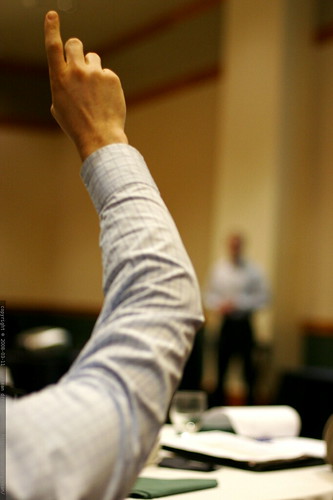 Identification is the ethical and professional standard for one-on-one interviews, but it is not the norm when a reporter documents someone speaking in public.
For example, reporters don’t walk into public meetings, shake hands with everyone in the room and introduce themselves before reporting the meeting’s happening, including quotes. They don’t deny being reporters; some people in the room may even recognize them as such (this is especially true if they are carrying a camera or with a photographer or videographer), but they don’t make an announcement of their profession.
Perhaps these professional norms are why I was so surprised to hear award-winning journalist Jacqui Banaszynski say she thinks reporters should identify themselves before live reporting at public events.
I heard Jacqui speak as part of several panels earlier this week at the Media Ethics 2011 conference at the University of Central Oklahoma in Edmond.
Attendees were encouraged to live tweet in advance of a session about the British phone hacking scandal. When the panel began, Jacqui, who also is a professor at the Missouri School of Journalism, said she was uncomfortable with the idea. She said journalists should make known in public events if they are sharing online. She also said identifying yourself as a reporter who is sharing information is a matter of ethics and manners.
“I’m uncomfortable with this kind of stealth world,” she said.
I disagree that journalists should identify themselves as such before live reporting at events.
Any person can live report information from a public happening. This is a fundamental right as a citizen. Therefore, people should be careful not to say things in public that they don’t want mass disseminated, especially in today’s tech-savvy world.
Requiring journalists to identify themselves at public events as a matter of ethics suggests that we can identify who is a journalist. In the days of citizen journalists and technology that allows everyone to record happenings, anyone with worthy photos, videos or even tweets can become someone who breaks the news. Are these people journalists? Should they have identified themselves?
I was not attending the conference as a journalist, but as an educator. However, if a newsworthy event happened there, I easily could have slipped into “journalist mode” and began live reporting. Some may argue that I did live report because I tweeted the bulk of the conference. I used to be a professional journalist. I now teach journalism. Should I have identified myself as a reporter? Even I’m not sure.
Identifying yourself as a journalist each time you’re in a public realm for reporting purposes goes against the norms of our profession. We don’t do this with any other live reporting unless we are performing a one-on-one interview. I fail to see why social media coverage should be different.
Let’s Talk Nerdy!
What do you think? Should journalists identify themselves before using technology to cover a public event? Does it matter if this is breaking news online verses via social media?