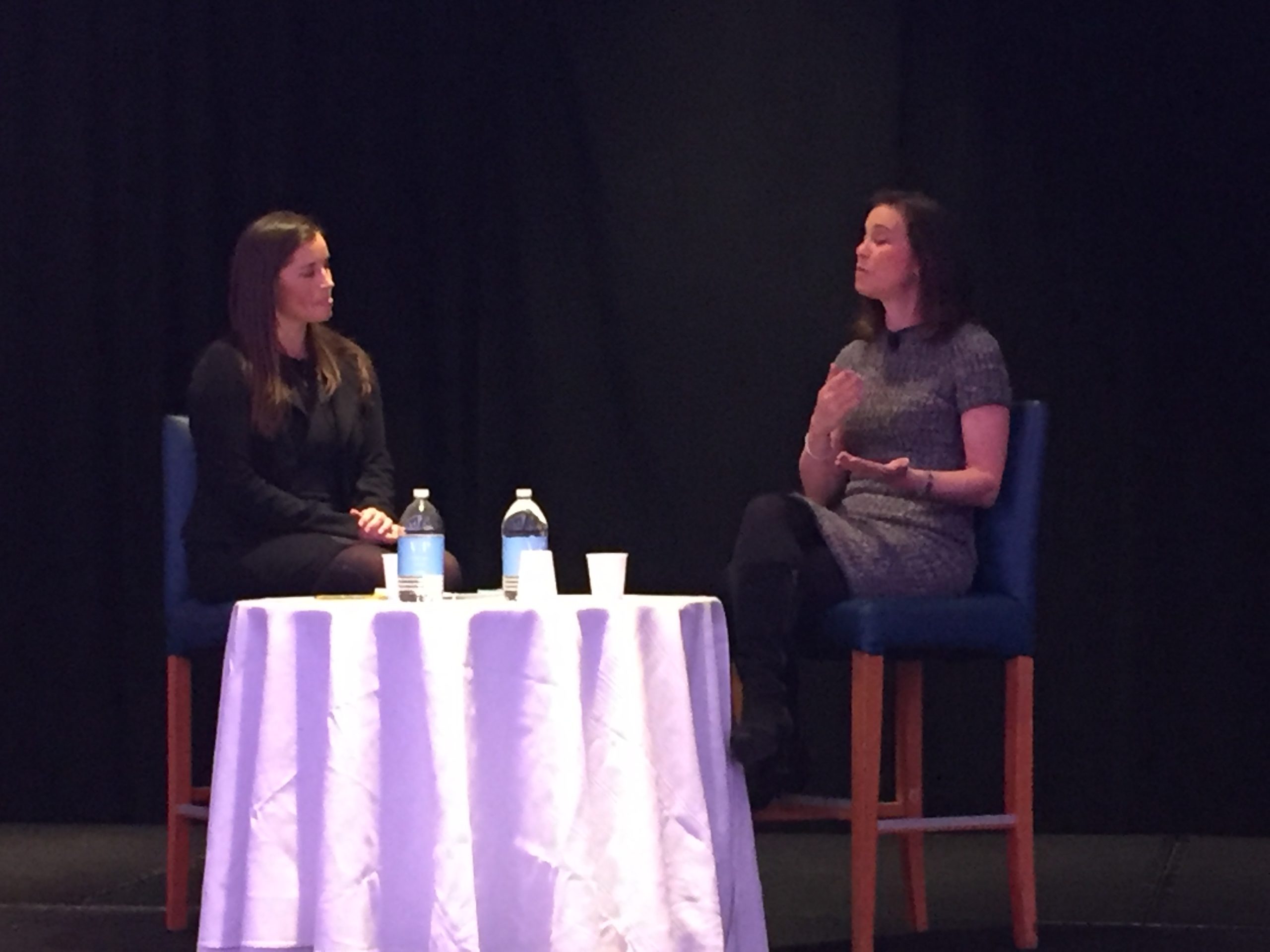
I started International Women’s Day listening to Joanne Lipman empower a ballroom full of student journalists to fight against sexual harassment and gender inequality. I can’t think of a better way to start the day.
Lipman, the author of That’s What She Said: What Men Need to Know (and Women Need to Tell Them) About Working Together, is a former USA Today editor-in-chief and the first woman to be deputy managing editor of The Wall Street Journal. In other words, Lipman, the first keynote speaker at College Media Association’s Spring National College Media Convention, knows what it’s like to work in a male-dominant industry.

Sexual harassment in the workplace is not a new problem, Lipman said. She said women have discussed it for decades, but we haven’t talked to men about it.
“That’s only half of the conversation,” she said.
Lipman set out to research gender inequality in the workplace and talk to men who were trying to reach across gender lines. What she found was inequality at all occupational levels, from food servers to Supreme Court justices. She also found that women are paid less, receive more personality-based reviews instead of performance evaluations, and are interrupted more at work, something she’s experienced personally.
“I used to think it was me. I thought it was my problem,” she said. “Research shows us that this happens to all women.”
People who belong to any under-represented group experience these issues at work. Those who belong to more than one under-represented group, like a female minority, experience it even more, Lipman said.
The #MeToo Movement has brought harassment to the forefront, displaying the predatory behavior that is sometimes an “open secret” in the workplace, Lipman said.
“If you don’t address it, you’re part of the problem,” she said. “You’re condoning this behavior.”
But sexual harassment is not just the celebrity stories that ignited the movement, Lipman said. It’s a “societal systemic issue” that Lipman told the equality-minded Millennial student audience they have the power to change.
“This is the first time in my lifetime when these issues are top of mind and discussable. That’s where I’m encouraged,” she said. “I hope you hold onto that and drive the change.”
Me too.